
On August 13, 2026, the Board of Immigration Appeals issued a major decision in Matter of Delcarmen-Lara, 29 I&N Dec. 830 (BIA 2026), overruling Matter of Arrabally and Yerrabelly, 25 I&N Dec. 771 (BIA 2012). The new decision is a significant and, in our view, deeply troubling change in immigration law. For fourteen years, Arrabally held that a temporary trip taken pursuant to advance parole was not a “departure” for purposes of the three- and ten-year unlawful-presence bars in INA § 212(a)(9)(B). Now that rule has changed.
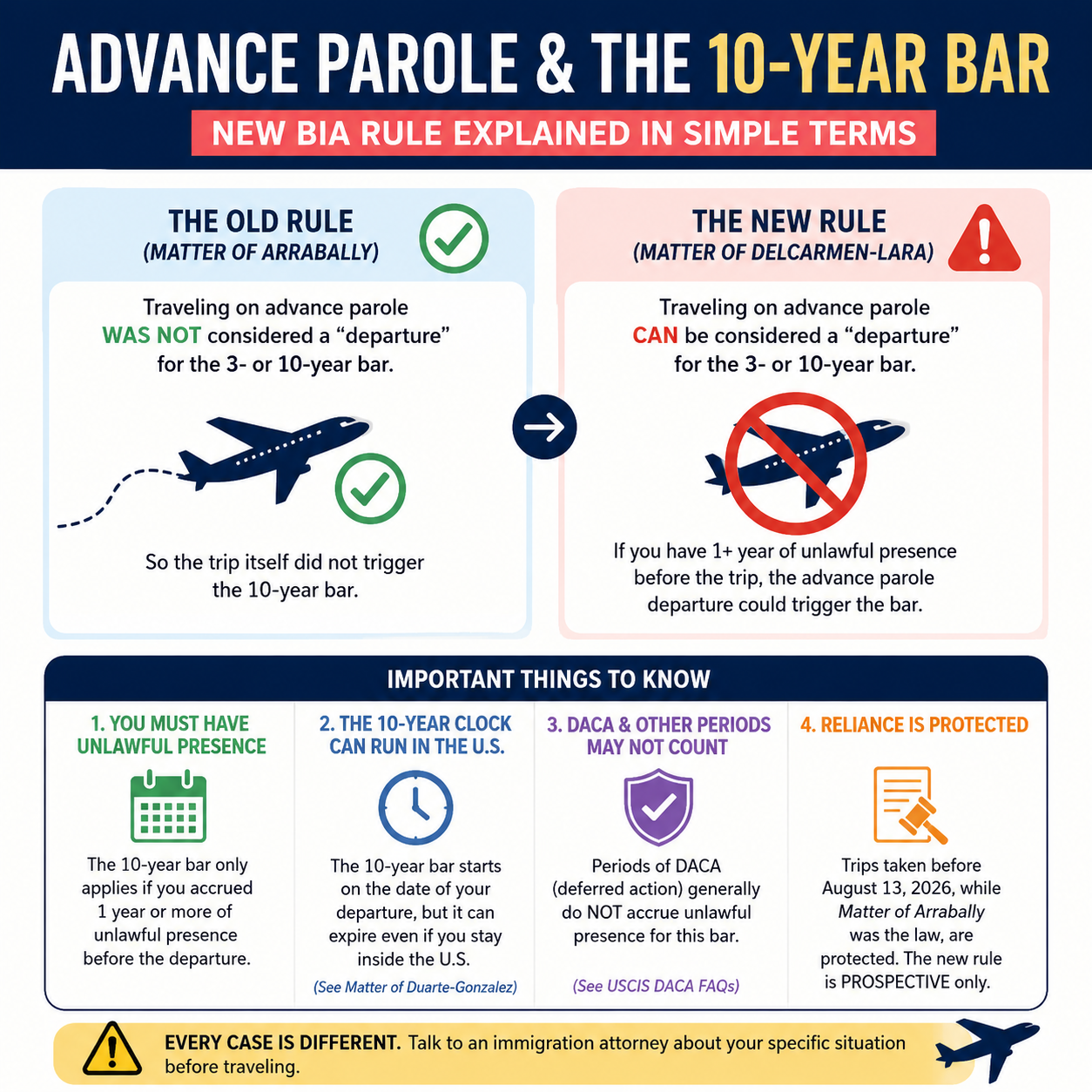
Under Delcarmen-Lara, leaving the United States pursuant to advance parole can constitute a “departure” for purposes of INA § 212(a)(9)(B)(i)(II).
That is bad law and bad policy. But it is also important not to overstate what the decision does.
Not every person who travels on advance parole has accrued unlawful presence. Not every person who once accrued unlawful presence is still within a three- or ten-year bar. And, critically, the BIA expressly made its new rule prospective.
For now, those distinctions matter enormously.
What Did the BIA Actually Hold?
INA § 212(a)(9)(B)(i)(II) generally makes a person inadmissible if the person:
- accrued one year or more of unlawful presence during a relevant stay in the United States;
- subsequently departed or was removed; and
- again seeks admission within ten years of that departure or removal.
For more than a decade, Matter of Arrabally and Yerrabelly held that a temporary departure pursuant to advance parole was not the kind of “departure” contemplated by this statute.
The reasoning made practical sense. Advance parole is not an ordinary decision to abandon the United States. The federal government authorizes the travel in advance with the expectation that the person may return and continue pursuing an immigration benefit or other authorized purpose.
The Board itself explained in Arrabally that advance-parole travel was qualitatively different from an ordinary departure because it presupposed the person’s anticipated return to the United States.
In Delcarmen-Lara, the Board discarded that reasoning.
Its new analysis focuses heavily on the ordinary dictionary meaning of “depart”: essentially, to leave.
Because Congress did not expressly write an advance-parole exception into § 212(a)(9)(B), the Board concluded that leaving pursuant to advance parole is still a “departure.”
Why Delcarmen-Lara Is Such a Troubling Decision
There are legitimate reasons to criticize this decision beyond simply disliking its result.
It reduces a complicated immigration mechanism to a dictionary definition
The Board’s analysis treats the question largely as though “departure” can be understood by opening a dictionary and asking whether someone physically left the country.
But Arrabally recognized that immigration statutes operate within a much more complicated legal framework.
A person traveling with advance parole has gone to DHS, requested advance authorization to travel, disclosed the proposed departure to the government, obtained the government’s permission, and traveled within that legal framework.
Treating that government-authorized travel as legally indistinguishable from an ordinary departure ignores the very feature that makes advance parole unique.
The question was never whether the person’s airplane physically crossed the border.
Of course it did.
The real question was whether Congress intended that government-authorized, temporary travel to carry the same unlawful-presence consequences as other departures.
Arrabally said no.
Delcarmen-Lara says that unless Congress expressly created an exception, the Board will treat them the same.
That is an extraordinarily formalistic way to resolve a question with life-changing consequences.
The government authorizes the travel and then uses the travel against the immigrant
There is something fundamentally perverse about the result.
DHS can authorize a noncitizen to travel internationally through advance parole. Yet under Delcarmen-Lara, making the very trip the government authorized may become the event that triggers a ground of inadmissibility.
An approval of advance parole has never been a guarantee that no other inadmissibility issue exists. Immigration lawyers know that.
But Arrabally gave immigrants and attorneys a clear, precedential answer to one very specific question: the advance-parole trip itself would not trigger § 212(a)(9)(B).
The BIA has now removed that protection.
The result is not merely technical. It changes whether people can safely attend funerals, visit gravely ill relatives, pursue educational or professional opportunities, or travel for humanitarian reasons after receiving permission from the federal government to do so.
The BIA itself recognizes that people relied on the old rule
Perhaps the most revealing portion of Delcarmen-Lara is the Board’s retroactivity discussion.
The BIA acknowledges that Arrabally was longstanding precedent. It recognizes reliance on that precedent. And it recognizes that changing the rule imposes a significant burden and can alter adjustment-of-status eligibility.
Those considerations were serious enough that the Board refused to make the new rule retroactive.
That is important protection for people who already traveled.
But it also highlights the disruptive nature of the decision itself.
For fourteen years, immigrants made enormously consequential decisions based on a published BIA precedent. Attorneys advised clients based on it. Government agencies adjudicated cases under it.
The rule did not exist in some obscure policy memorandum that could disappear overnight.
It was a published precedent decision of the Board of Immigration Appeals.
Now the Board has simply decided that its former interpretation was wrong.
But Do Not Panic: Advance Parole Does Not Automatically Mean a Ten-Year Bar
This point is critical.
Some of the immediate discussion surrounding Delcarmen-Lara risks collapsing two completely different questions:
Question 1: Is advance-parole travel now considered a “departure”?
Under Delcarmen-Lara, going forward, potentially yes.
Question 2: Does that particular person actually have enough unlawful presence to trigger INA § 212(a)(9)(B)?
That requires an entirely separate analysis.
A person does not trigger the ten-year bar merely because they traveled on advance parole.
The person must first have accumulated one year or more of qualifying unlawful presence before the relevant departure.
And “unlawful presence” is a technical statutory concept. It is not synonymous with every period in which someone lacked lawful immigration status.
“Out of Status” Does Not Always Mean “Accruing Unlawful Presence”
This distinction is particularly important for DACA recipients.
USCIS expressly recognizes that deferred action does not confer lawful immigration status. But USCIS also states that a person generally does not accrue unlawful presence for inadmissibility purposes while deferred action is in effect.
USCIS explains this distinction directly in its DACA Frequently Asked Questions.
That means someone can technically lack lawful immigration “status” while nevertheless not accumulating unlawful presence for purposes of § 212(a)(9)(B).
Those are different legal concepts.
This matters enormously after Delcarmen-Lara.
For example, a DACA recipient who obtained DACA young enough and maintained continuous deferred action may have substantially less unlawful presence than someone might assume simply by looking at the number of years that person has lived in the United States.
Periods before age 18 also generally do not count toward § 212(a)(9)(B)’s unlawful-presence calculation.
There are also statutory exceptions and other circumstances in which particular periods may not count as unlawful presence.
So the correct question is not:
“Has this person lived in the United States without a green card for more than ten years?”
It is:
“Exactly how much statutory unlawful presence did this person accrue before the relevant departure?”
Those are very different questions.
Why This Is Especially Important for DACA Advance-Parole Travelers
Many of the people immediately worried about Delcarmen-Lara are DACA recipients.
But DACA cases illustrate precisely why lawyers cannot jump from “advance parole” to “ten-year bar.”
Imagine someone entered the United States as a young child.
Unlawful presence for § 212(a)(9)(B) generally does not accrue before age 18.
The person later receives DACA, and periods during which deferred action is in effect generally do not accrue unlawful presence for this purpose either.
Depending on the person’s age when DACA was first granted, renewal history, gaps, and other facts, that person may never have accumulated the one year of unlawful presence necessary to trigger § 212(a)(9)(B)(i)(II).
Another DACA recipient may have accumulated more than one year between turning 18 and receiving DACA.
Another may have had significant gaps between DACA periods.
Those three people could have completely different § 212(a)(9)(B) analyses despite all being “DACA recipients who traveled on advance parole.”
The dates matter.
And There Is Another Major Point: The Ten-Year Period Can Run While You Are Inside the United States
This is another issue that is frequently misunderstood.
The ten-year unlawful-presence bar does not necessarily require someone to spend ten years physically outside the United States.
The BIA already decided this question in Matter of Duarte-Gonzalez, 28 I&N Dec. 688 (BIA 2023).
In Duarte-Gonzalez, the Board held that a person subject to the temporary bar under § 212(a)(9)(B) is not required to reside outside the United States during the ten-year period in order for that period eventually to expire.
The statutory clock runs from the relevant departure.
USCIS takes the same position in its Policy Manual guidance concerning INA § 212(a)(9)(B).
USCIS states that the three- or ten-year period continues running regardless of whether the person later returns to the United States during that period.
So consider this scenario:
A person accrued more than one year of unlawful presence.
The person departed the United States in 2014.
The person later returned and has remained in the United States.
If the relevant ten-year period began with the 2014 departure, that ten-year period may already have expired in 2024.
The fact that the person spent some or even all of those ten years physically in the United States does not, by itself, stop the clock under Duarte-Gonzalez.
That does not mean the person’s return was lawful or that no other ground of inadmissibility applies. An unlawful reentry, for example, may implicate the far more serious provisions of INA § 212(a)(9)(C), among other possible consequences.
But for the specific temporary inadmissibility period under § 212(a)(9)(B), residence outside the United States for the entire ten years is not required.
That can completely change the analysis in an individual case.
So Someone May Have Had a Ten-Year Bar and Already Finished It
Exactly.
This is why saying “Delcarmen-Lara means you triggered a ten-year bar” can be dangerously incomplete.
Suppose someone accrued one year of unlawful presence and then made a qualifying departure in 2013.
The ten-year period associated with that departure would ordinarily have run through 2023.
If more than ten years have now elapsed since that relevant departure, the person does not remain inadmissible under § 212(a)(9)(B)(i)(II) based on that old unlawful presence and departure merely because they spent the intervening period in the United States.
That was the essential issue in Duarte-Gonzalez.
The BIA held that the statute does not require the person to remain abroad while the ten years run.
So when reviewing a case after Delcarmen-Lara, lawyers need to determine at least:
- Was there actually unlawful presence?
- How much?
- When was it accrued?
- Was there a prior departure that already started a three- or ten-year clock?
- Has that statutory period already expired?
- Did a later entry create some different inadmissibility issue, particularly under § 212(a)(9)(C)?
- Did the person subsequently accrue a new period of unlawful presence?
- When did the advance-parole departure occur?
Without that chronology, there is no reliable answer.
What About People Who Already Traveled in Reliance on Arrabally?
This remains the most important piece of good news in an otherwise terrible decision.
The BIA expressly made Delcarmen-Lara prospective. The respondent herself had departed and returned pursuant to advance parole on January 1, 2024.
If the Board had applied its newly announced interpretation retroactively, that historical trip could potentially have been analyzed as a triggering departure. The Board refused to do so.
After considering the reliance interests created by Arrabally, the BIA stated that it would apply its new holding prospectively and declined to decide whether the respondent’s own 2024 advance-parole trip constituted a § 212(a)(9)(B) departure.
That is powerful language for people who completed advance-parole travel before August 13, 2026.
Did the BIA Just Retroactively Give Everyone Who Previously Traveled a Ten-Year Bar?
No.
That is not what the decision says.
Someone who completed advance-parole travel while Arrabally governed has a strong argument directly from Delcarmen-Lara itself that the new interpretation cannot be applied retroactively to that historical trip.
The respondent in this case is the clearest example.
Her travel occurred in 2024.
The BIA decided her case in 2026.
Yet it declined to apply its new rule to the 2024 trip because the holding is prospective.
What If My Adjustment Application Is Still Pending?
The fact that USCIS adjudicates an adjustment application after August 13, 2026 should not, standing alone, convert a completed pre-Delcarmen-Lara advance-parole trip into a departure under the new rule.
Again, Delcarmen-Lara itself involved later adjudication of earlier travel.
The respondent’s trip occurred more than two years before the precedent decision.
The Board nevertheless treated the prospectivity question based on the historical travel rather than simply applying whatever interpretation existed on the date it adjudicated her motion.
That is one of the strongest aspects of the opinion for people with pending cases.
What If I Have Advance Parole but Have Not Left Yet?
This is the group that needs immediate caution.
The rule changed on August 13, 2026.
A person considering a new advance-parole departure should no longer assume Arrabally prevents that trip from constituting a departure under § 212(a)(9)(B).
But even here, the answer is not automatically “do not travel.”
First determine whether the person has the requisite unlawful presence at all.
For some people, especially certain DACA recipients, the answer may be no.
For others, the relevant three- or ten-year period associated with an earlier departure may already have expired.
For still others, there may be substantial unlawful presence and no expired period, making future travel dramatically riskier under Delcarmen-Lara.
The analysis has to be individualized.
What If Someone Departed Before August 13 but Is Still Abroad?
This remains a difficult fact pattern.
Delcarmen-Lara strongly protects reliance on the former rule, and § 212(a)(9)(B) focuses expressly on the date of “departure or removal.”
But the respondent in Delcarmen-Lara had both departed and returned before the new decision.
The Board did not squarely decide what happens when the departure occurred while Arrabally controlled but the person had not yet returned when Delcarmen-Lara was issued.
That case deserves individualized analysis rather than categorical assurances.
The Bottom Line
Delcarmen-Lara is a harsh and unnecessary reversal of a rule immigrants and lawyers relied upon for fourteen years. It takes a sophisticated government-created travel mechanism and reduces the statutory question to the proposition that leaving means leaving. Worse, it allows the government to authorize someone’s travel and then potentially attach a severe immigration consequence to taking that authorized trip.
But panic is not legal analysis.
Advance parole alone does not create a ten-year bar.
The person must have actually accrued the necessary unlawful presence. Some people who lack lawful immigration status nevertheless do not accrue unlawful presence during particular periods, including periods of deferred action.
Some people never accumulated enough unlawful presence to trigger the ten-year bar at all.
And some people who once triggered § 212(a)(9)(B) may already have completed the three- or ten-year statutory period while physically present inside the United States, as the BIA held in Matter of Duarte-Gonzalez.
Finally, people who already completed advance-parole travel before August 13, 2026 have the extraordinarily important protection of Delcarmen-Lara‘s own retroactivity holding:
The new rule is prospective.
So before anyone concludes that an advance-parole traveler now has a ten-year bar, build the timeline.
Calculate the unlawful presence.
Identify every departure.
Determine whether a prior statutory period already ran.
Examine DACA and other periods during which unlawful presence may not have accrued.
And distinguish travel completed under Arrabally from travel contemplated after Delcarmen-Lara.
The Board may have made the law worse today.
That does not mean every person affected by advance parole suddenly became inadmissible.
Primary Sources
- Matter of Delcarmen-Lara, 29 I&N Dec. 830 (BIA 2026)
- Matter of Arrabally and Yerrabelly, 25 I&N Dec. 771 (BIA 2012)
- Matter of Duarte-Gonzalez, 28 I&N Dec. 688 (BIA 2023)
- INA § 212(a)(9)(B), 8 U.S.C. § 1182(a)(9)(B)
- USCIS Policy Manual: Effect of Seeking Admission Following Accrual of Unlawful Presence
- USCIS DACA Frequently Asked Questions
This article provides general information regarding a newly issued immigration precedent and does not constitute legal advice. Unlawful-presence calculations and grounds of inadmissibility are highly fact-specific. A person considering international travel should obtain individualized advice based on their complete immigration history.